
When people search for meaning of, they usually want to understand what a word, phrase, abbreviation, emoji, or slang term really means. Sometimes the answer is simple. Other times, the meaning changes depending on where the word is used, who is saying it, and what the conversation is about.
In everyday life, words do more than just give information. They can show emotion, attitude, humor, confusion, love, sarcasm, or even anger. That is why understanding the meaning of something is not only about checking a dictionary. It is also about reading the context carefully.
This guide explains the meaning of words, slang, abbreviations, emojis, symbols, and social media terms in a simple and beginner-friendly way.
What Is the Meaning Of?
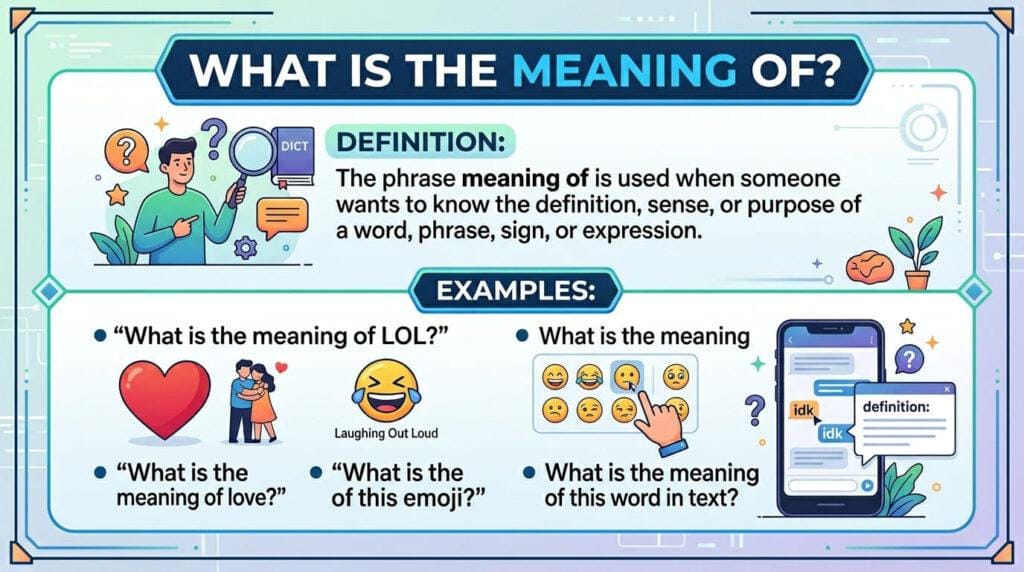
The phrase meaning of is used when someone wants to know the definition, sense, or purpose of a word, phrase, sign, or expression.
For example:
“What is the meaning of love?”
“What is the meaning of LOL?”
“What is the meaning of this emoji?”
“What is the meaning of this word in text?”
In simple words, meaning of helps you understand what something represents.
Simple Definition of Meaning Of
The meaning of something is the idea, explanation, or message behind it.
For example:
The meaning of “happy” is feeling joy.
The meaning of “ASAP” is as soon as possible.
The meaning of “❤️” is love, care, or affection.
So, when you ask for the meaning of something, you are asking, “What does this actually mean?”
For more chat abbreviations, you can also read our guide on ACC Full Form in Chat.
Why People Search for Meaning Of Online
People search for meaning of online because language changes very fast, especially on social media and texting apps.
A word that means one thing in school or work may mean something different on TikTok, Instagram, Snapchat, or WhatsApp.
People usually search online because:
They saw a new slang term.
They received a confusing message.
They want to understand an abbreviation.
They are unsure about an emoji.
They want to avoid misunderstanding someone.
Online language moves quickly, and searching for meanings helps people stay updated.
Meaning Of in Everyday Language
In everyday language, meaning of is used to understand normal words and phrases.
Example:
“What is the meaning of honesty?”
“What is the meaning of friendship?”
“What is the meaning of success?”
These questions are not only about dictionary definitions. They can also include feelings, values, and personal understanding.
Meaning Of in Text and Chat
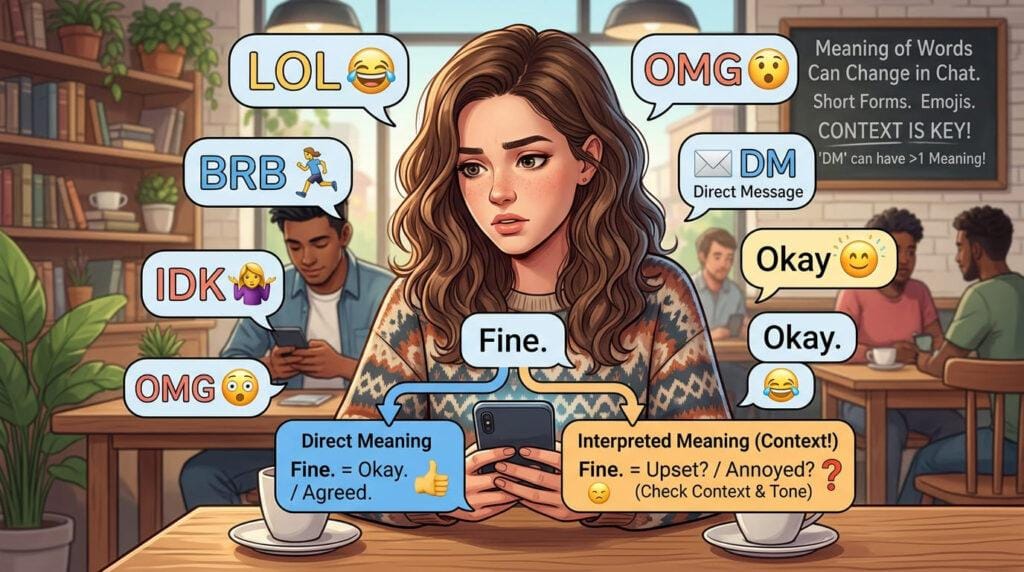
In texting, the meaning of words can change because people write quickly. They use short forms, emojis, slang, and incomplete sentences.
A simple word in text can carry extra meaning depending on tone.
For example:
“Fine.” can mean okay.
“Fine.” can also mean the person is upset.
That is why text messages need context.
How Meaning Of Is Used in Messages
When people text, they often ask:
“What does this mean?”
“What is the meaning of this message?”
“What does this word mean in chat?”
In messages, meaning is affected by:
The words used
The emojis added
The person’s mood
The situation
The relationship between people
For example:
“Okay 😊” sounds friendly.
“Okay.” may sound cold or serious.
Same word, different feeling.
If you often get confused by short texting terms, check our detailed guide on FS Mean in Text.
Meaning Of Common Text Abbreviations
Texting is full of abbreviations. These short forms save time and make chatting faster.
Common examples:
LOL means laughing out loud.
BRB means be right back.
IDK means I don’t know.
OMG means oh my God.
TBH means to be honest.
But one abbreviation can have more than one meaning. That is why context matters.
For example, “DM” can mean direct message, but in another context, it can mean something else.
Examples of Meaning Of in Chat
Here are some simple examples:
“What is the meaning of LOL?”
It means the person is laughing or finds something funny.
“What is the meaning of IDK?”
It means “I don’t know.”
“What is the meaning of WYD?”
It means “What are you doing?”
“What is the meaning of 😂?”
It usually means laughing hard or finding something funny.
Chat meanings are usually short, casual, and based on fast communication.
Meaning Of Words in English
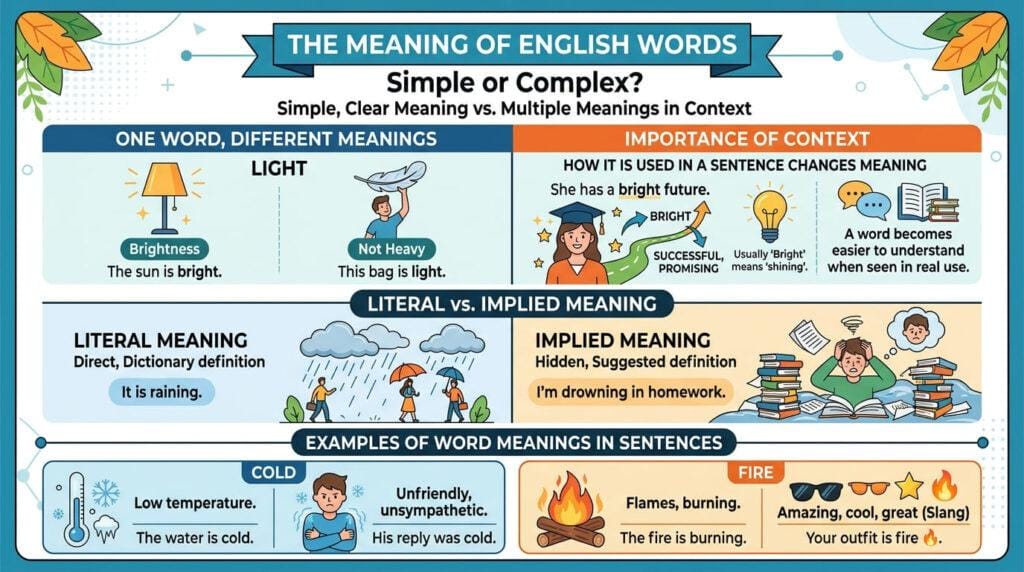
The meaning of English words can be simple or complex. Some words have one clear meaning, while others have many meanings.
For example:
“Light” can mean not heavy.
“Light” can also mean brightness.
This is why English learners and even native speakers often search for word meanings online.
How to Understand the Meaning Of English Words
To understand the meaning of an English word, look at how it is used in a sentence.
Example:
“She has a bright future.”
Here, “bright” does not mean light or shiny. It means successful or promising.
Another example:
“This bag is light.”
Here, “light” means not heavy.
A word becomes easier to understand when you see it in real use.
Difference Between Literal and Implied Meaning
A literal meaning is the direct meaning of a word.
Example:
“It is raining.”
This means water is falling from the sky.
An implied meaning is the hidden or suggested meaning.
Example:
“I’m drowning in homework.”
This does not mean the person is actually underwater. It means they have too much homework.
Many online phrases use implied meanings, especially in memes and captions.
Examples of Word Meanings in Sentences
Here are some examples:
“Cold” means low temperature.
Example: The water is cold.
“Cold” can also mean unfriendly.
Example: His reply was cold.
“Fire” means flames.
Example: The fire is burning.
“Fire” can also mean amazing in slang.
Example: Your outfit is fire 🔥.
The same word can change meaning depending on the sentence.
Another popular online abbreviation people search for is What Does YT Mean.
Meaning Of Slang Terms
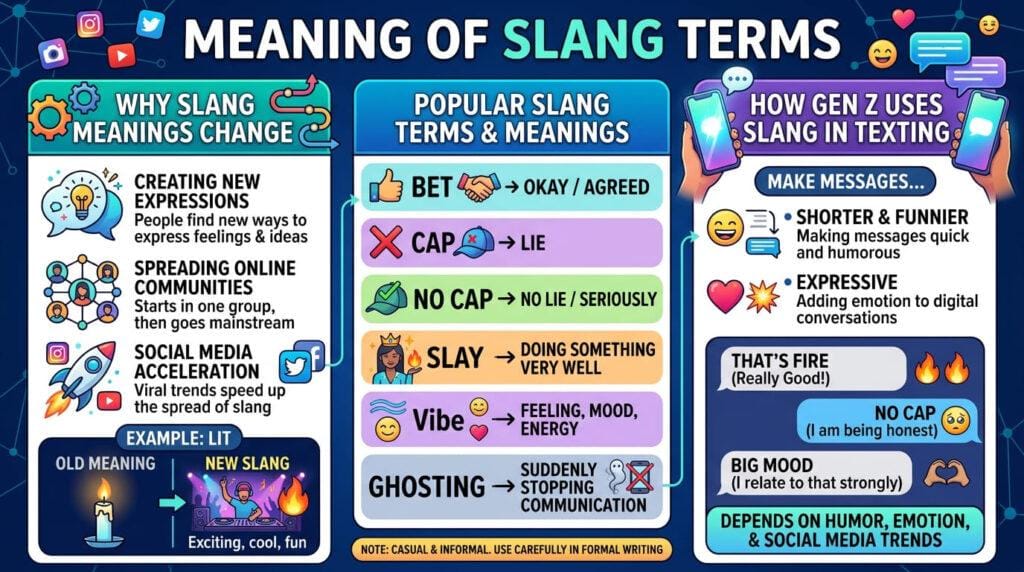
Slang terms are informal words used in casual conversation, texting, and social media. Slang can be fun, expressive, and creative.
But slang can also confuse people because it changes quickly.
Why Slang Meanings Change Over Time
Slang changes because people create new ways to express feelings and ideas.
A word may start in one online community and then become popular everywhere.
For example:
“Lit” once simply meant something was burning or bright.
Now, in slang, it can mean exciting, cool, or fun.
Social media makes slang spread faster than ever.
Popular Slang Terms and Their Meanings
Here are some common slang examples:
“Bet” means okay or agreed.
“Cap” means lie.
“No cap” means no lie or seriously.
“Slay” means to do something very well.
“Vibe” means feeling, mood, or energy.
“Ghosting” means suddenly stopping communication.
Slang is usually casual, so it should be used carefully in formal writing.
How Gen Z Uses Slang in Texting
Gen Z uses slang to make messages shorter, funnier, and more expressive.
For example:
“That’s fire” means that is really good.
“No cap” means I am being honest.
“Big mood” means I relate to that strongly.
Gen Z slang often depends on humor, emotion, and social media trends.
Meaning Of Abbreviations and Acronyms
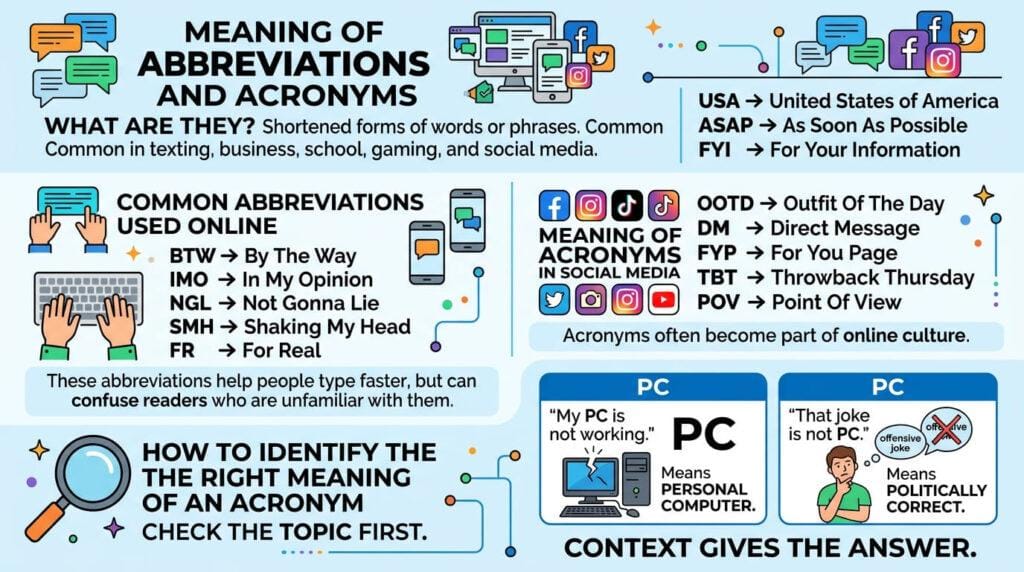
Abbreviations and acronyms are shortened forms of words or phrases. They are common in texting, business, school, gaming, and social media.
For example:
USA means United States of America.
ASAP means as soon as possible.
FYI means for your information.
Common Abbreviations Used Online
Some common online abbreviations include:
BTW means by the way.
IMO means in my opinion.
NGL means not gonna lie.
SMH means shaking my head.
FR means for real.
These abbreviations help people type faster, but they can confuse readers who are unfamiliar with them.
Meaning Of Acronyms in Social Media
On social media, acronyms are used in captions, comments, bios, and messages.
Examples:
OOTD means outfit of the day.
DM means direct message.
FYP means For You Page.
TBT means throwback Thursday.
POV means point of view.
Acronyms often become part of online culture.
How to Identify the Right Meaning of an Acronym
To find the correct meaning of an acronym, check the topic first.
For example:
“PC” can mean personal computer.
“PC” can also mean politically correct.
If someone says:
“My PC is not working.”
They probably mean personal computer.
If someone says:
“That joke is not PC.”
They probably mean politically correct.
Context gives the answer.
On WhatsApp and social media, users also search for DP meaning in chat to understand profile-related
Meaning Of Emojis and Symbols
Emojis and symbols are a big part of online communication. They can show emotions, reactions, jokes, or hidden meanings.
A single emoji can change the whole tone of a message.
Meaning Of Popular Emojis in Texting
Here are some common emoji meanings:
😂 means laughing.
❤️ means love or care.
🔥 means cool, attractive, or excellent.
😭 can mean crying or laughing very hard.
💀 often means “I’m dead laughing” in slang.
🙏 can mean prayer, thanks, or please.
Emoji meanings are not always fixed. They depend on context.
Meaning Of Symbols on Social Media
Symbols are also used in usernames, captions, and comments.
For example:
means hashtag.
@ is used to tag someone.
… can show pause, hesitation, or suspense.
!! can show excitement or strong emotion.
? can show confusion or a question.
Symbols make online writing more expressive.
How Emoji Meanings Depend on Context
The same emoji can have different meanings.
Example:
“Nice job 😂” may sound playful.
“Nice job 😂” may also sound sarcastic.
Another example:
“Okay ❤️” sounds warm and caring.
“Okay 👍” may sound simple or slightly distant, depending on the relationship.
So, emojis should always be read with the full message.
Meaning Of in Social Media
Social media has its own language. Words, slang, emojis, and acronyms often become popular through viral posts, memes, videos, and comments.
The meaning of a term can change from one platform to another.
Meaning Of Terms on Instagram
On Instagram, people use words related to photos, stories, captions, and engagement.
Common terms:
DM means direct message.
IG means Instagram.
Bio means profile description.
Reel means short video.
Story means temporary post.
Instagram language is often visual, stylish, and caption-based.
Meaning Of Terms on TikTok
TikTok has many trend-based terms.
Common examples:
FYP means For You Page.
POV means point of view.
Trend means a popular video style.
Duet means responding to another video.
Viral means becoming very popular quickly.
TikTok meanings often depend on trends and sound clips.
Meaning Of Terms on Snapchat
Snapchat terms are more private and chat-based.
Examples:
Snap means a photo or video message.
Streak means daily snapping between users.
Bitmoji means a personal cartoon avatar.
SB can mean snap back.
Story means a post visible for a limited time.
Snapchat language is usually casual and personal.
Meaning Of Terms on Facebook
Facebook uses terms related to posts, groups, pages, and reactions.
Examples:
Timeline means your profile activity.
Share means reposting content.
Tag means mentioning someone.
Group means a community space.
Reaction means responding with emojis like Like, Love, or Wow.
Facebook meanings are often connected to community and sharing.
Meaning Of Terms on WhatsApp
WhatsApp language is mostly based on direct messages and groups.
Common terms:
DP means display picture.
PM means private message.
GC means group chat.
Forward means sending a message to others.
Last seen shows when someone was last active.
WhatsApp meanings are usually simple but can still depend on tone.
Meaning Of in Different Contexts
The meaning of a word or phrase changes depending on where and how it is used.
A term in a friendly chat may not mean the same thing in a work email or gaming chat.
Meaning Of in Casual Conversation
In casual conversation, people use relaxed language.
Example:
“That’s sick.”
In normal English, “sick” means ill.
In slang, it can mean amazing or impressive.
Casual conversation allows more flexible meanings.
Meaning Of in Professional Communication
In professional communication, words should be clear and respectful.
For example:
“ASAP” means as soon as possible, but it can sound urgent or demanding.
Instead of saying:
“Send this ASAP.”
A better professional version is:
“Please send this as soon as you can.”
Tone matters a lot in work messages.
Meaning Of in Online Communities
Online communities often create their own terms.
For example, gamers, fandoms, students, and social media groups may use special words that outsiders do not understand.
A word may have a very specific meaning inside one community.
That is why you should always consider the group or platform.
Meaning Of in Gaming Chats
Gaming chats have many abbreviations and slang terms.
Examples:
GG means good game.
AFK means away from keyboard.
OP means overpowered.
NPC means non-player character.
Noob means beginner or inexperienced player.
Gaming language is fast because players need quick communication.
You may also like our simple explanation of ISK Mean in Text.
How to Find the Correct Meaning Of a Word or Phrase
Finding the correct meaning is not only about checking one definition. You need to look at the full situation.
A word can have multiple meanings, but the context usually reveals the right one.
Check the Context First
Context means the words, situation, and tone around the term.
Example:
“She is cold.”
This could mean she feels low temperature.
It could also mean she is acting emotionally distant.
The surrounding sentence helps you decide.
Look at How the Word Is Used
Look at the full sentence.
Example:
“That song is fire.”
Here, “fire” means excellent, not actual flames.
Another example:
“Turn off the fire.”
Here, “fire” means real flames or heat.
Usage makes meaning clear.
Compare Different Possible Meanings
Some words have several meanings. Compare them before choosing one.
Example:
“Wave” can mean movement of the hand.
“Wave” can mean ocean water movement.
“Wave” can mean a sudden increase in something.
The correct meaning depends on the sentence.
Use Examples to Understand Better
Examples make meanings easier to understand.
Instead of only reading:
“Confident means sure of yourself.”
Read an example:
“She spoke confidently during the presentation.”
Now the meaning feels clearer and more natural.
Meaning Of vs Definition
Many people think meaning and definition are exactly the same. They are related, but not always identical.
A definition is usually more formal. Meaning can be broader and more flexible.
Difference Between Meaning and Definition
A definition explains a word clearly, often like a dictionary.
A meaning can include emotion, context, tone, and real-life use.
Example:
The definition of “home” is a place where someone lives.
The meaning of “home” can be comfort, family, safety, or belonging.
So, meaning can feel deeper than definition.
When to Use Meaning Of
Use meaning of when you want to understand the idea, feeling, or use behind something.
Examples:
“What is the meaning of this quote?”
“What is the meaning of this emoji?”
“What is the meaning of this slang?”
This phrase is helpful when context matters.
When to Use Definition Of
Use definition of when you want a direct and formal explanation.
Examples:
“What is the definition of democracy?”
“What is the definition of photosynthesis?”
“What is the definition of communication?”
Definition is better for school, academic writing, and formal explanations.
Common Mistakes When Searching Meaning Of
Many people misunderstand words because they search too quickly or ignore context.
A quick search can help, but it does not always give the exact meaning for your situation.
Ignoring the Context
This is the biggest mistake.
For example:
“Bad” usually means not good.
But in slang, “bad” can sometimes mean attractive or impressive.
Without context, you may choose the wrong meaning.
Confusing Slang With Formal Meaning
Slang and formal English are different.
Example:
“That outfit is sick.”
In slang, this means the outfit is cool.
In formal English, “sick” means ill.
Do not use slang meanings in formal writing unless the situation allows it.
Using the Wrong Platform Meaning
A term on TikTok may not mean the same thing on WhatsApp or in a work email.
For example:
“POV” is very common on TikTok and usually means point of view.
In another setting, people may not understand it immediately.
Platform changes meaning.
Examples of Meaning Of in Sentences
Here are simple examples to show how “meaning of” is used naturally.
Meaning Of in Simple Sentences
“What is the meaning of this word?”
“The meaning of kindness is helping others.”
“I do not understand the meaning of this sentence.”
“The meaning of success is different for everyone.”
These examples are easy and direct.
Meaning Of in Text Messages
“What’s the meaning of LOL?”
“Do you know the meaning of this emoji?”
“What is the meaning of ‘bet’ in text?”
“I saw this slang online. What does it mean?”
In texting, people usually ask for quick and simple explanations.
Meaning Of in Social Media Captions
“The meaning of peace is different for everyone.”
“Finding the meaning of life one day at a time.”
“The meaning of happiness is hidden in small moments.”
“Learning the meaning of self-love.”
Captions often use “meaning of” in an emotional or thoughtful way.
Why Understanding the Meaning Of Words Matters
Understanding meanings helps people communicate better. It prevents confusion and makes conversations smoother.
When you understand words correctly, you respond with more confidence.
Better Communication
Clear meaning creates clear communication.
If both people understand the same meaning, the conversation becomes easier.
For example:
If someone says “BRB,” knowing it means “be right back” prevents confusion.
Avoiding Misunderstandings
Misunderstandings happen when one person reads a word differently from another.
Example:
A sarcastic message may look rude if you do not understand the tone.
Knowing the meaning of words, emojis, and slang helps you avoid unnecessary confusion.
Improving Vocabulary and Confidence
Learning meanings improves vocabulary.
The more words you understand, the easier it becomes to read, write, speak, and text confidently.
It also helps you understand social media, online trends, and everyday conversations better.
FAQs About Meaning Of
What does meaning of mean?
Meaning of means the explanation, idea, or sense behind a word, phrase, symbol, emoji, or expression. It tells you what something represents.
How do I find the meaning of a word?
You can find the meaning of a word by checking its sentence, context, tone, and examples. A dictionary can help, but real-life usage is also important.
What is the meaning of slang?
Slang is informal language used in casual conversations, texting, and social media. Its meaning can change depending on trends and online culture.
Why do words have different meanings?
Words have different meanings because language changes with time, culture, situation, and usage. One word can mean different things in different contexts.
Is meaning of the same as definition?
Not always. A definition is usually a formal explanation, while meaning can include context, emotion, tone, and real-life use.
Conclusion
Understanding the meaning of words, slang, abbreviations, emojis, and symbols helps you communicate clearly in everyday life and online conversations.
A word may look simple, but its meaning can change with tone, platform, and context. That is why checking examples and reading the full message is important.
Whether you are reading a text, social media caption, comment, or professional message, knowing the right meaning helps you avoid confusion and respond with confidence.